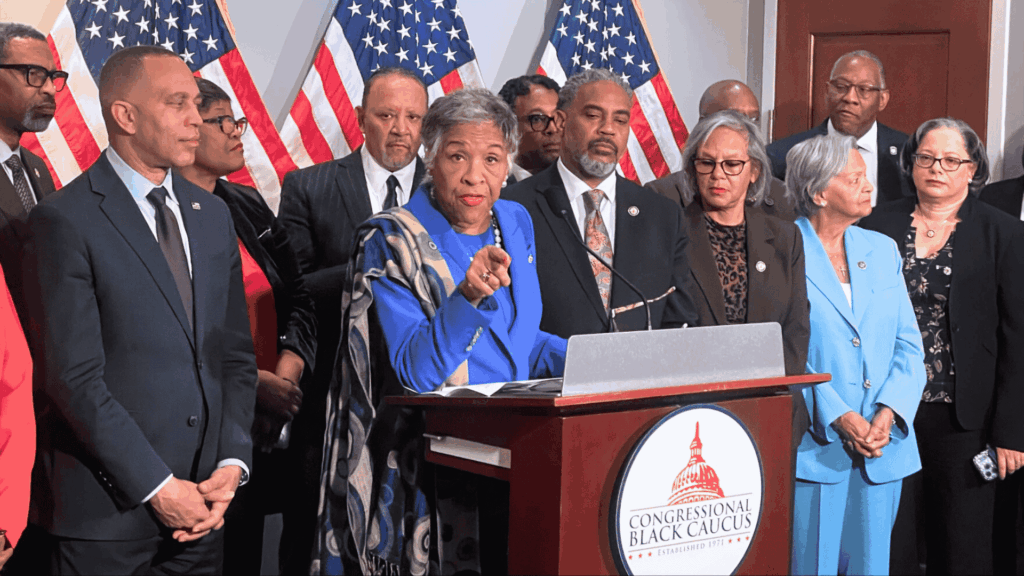
On February 11, 2026, the Congressional Black Caucus (CBC) held a press conference alongside leading civil rights organizations to announce a coordinated effort to push back against what they described as anti-Black policies and the rollback of civil rights protections under the Trump administration.
The press conference was led by CBC Chair Representative Yvette Clarke of New York. Standing with her were House Democratic Leader Hakeem Jeffries and representatives from major national organizations, including the NAACP, the National Urban League, the Divine Nine historically Black fraternities and sororities, the National Council of Negro Women, the National Coalition on Black Civic Participation (NCBCP), and other advocacy groups.
The message was clear: Black leaders are not asleep. They are organizing, strategizing, and mobilizing.
Preparing for the Fight Ahead
The press conference followed a Voting Rights & Redistricting Strategy Summit held in late January, where Black leaders gathered to prepare for a pending Supreme Court decision that could significantly weaken Section 2 of the Voting Rights Act of 1965. That section has long served as a critical protection against racial discrimination in voting.
Speakers emphasized that the work ahead is both defensive and proactive, defending hard-fought gains while advancing legislation such as the John Lewis Voting Rights Advancement Act. The tone was sober but determined.
Responding to Policy Rollbacks
CBC members and civil rights leaders argued that over the past year, executive actions and policy shifts have disproportionately harmed Black communities. They cited attacks on diversity, equity, and inclusion (DEI) initiatives in the public and private sector, which they say have led to widespread job losses and the rising unemployment rate in the Black community. The unemployment rate for African Americans is now as high as it was during the pandemic; no other ethnic group is experiencing this level of unemployment. They raised concerns about redistricting efforts in several states and reductions in civil rights enforcement across several sectors of the federal government.
While policy debates will continue, the broader concern voiced at the press conference centered on preserving equal opportunity and protecting access to the ballot box.
A Unified Strategy of Resistance and Renewal
The coalition made clear that they intend to use every lawful tool available: litigation, legislative advocacy, public education, peaceful protest, economic pressure campaigns, and collaboration with state attorneys general to challenge policies they believe undermine civil rights protections.
But beyond resistance, the press conference carried a message of renewal.
Black history has always been marked by organized response, from Reconstruction to the Civil Rights Movement to modern voting rights advocacy. The leaders gathered on February 11 framed this moment as another chapter in that legacy.
For many in the Black community, the press conference served as reassurance that there is coordinated leadership prepared to confront the challenges ahead. It signaled that mobilization is underway, not just inside Congress, but across civic organizations, faith institutions, fraternities and sororities, and grassroots networks nationwide.
The message was not one of panic, but of preparation.
As legal battles unfold and the 2026 midterm elections approach, the press conference underscored a broader truth: progress has never been automatic. It has always required organized, sustained engagement. And according to the leaders who stood together on February 11, that engagement has already begun.